New York
Lost and FoundNew York functions in the narrative as both a point of origin and a measure of worldly success. Characters invoke it when explaining who they were before moving elsewhere, yet their recollections complicate its prestige: the city represents education and opportunity, but also a life dominated by work and insufficient personal connection.
A Place Left Behind
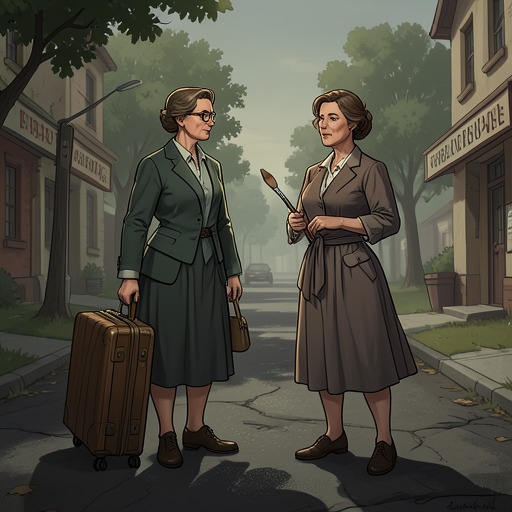
New York is established as part of Eve Waters’s recent history when she tells Mrs. Beaumont that she moved from New York only about a month earlier. Her answer places her arrival in Heather’s Forge against a sharply different former setting and emphasizes the freshness of her relocation. New York is therefore not merely a geographical reference; it marks the threshold between the life Eve has abandoned and the small-town environment in which she is attempting to begin again.
Eve’s statement that she came from New York alone gives the move an additional social charge. The question of whether she arrived alone makes the city part of the uncertainty surrounding her new identity, while her brief answer presents relocation as a concrete fact rather than an explanation of everything that happened before it. The city remains behind her, but it continues to shape how local people read her.
Work, Isolation, and the Former Life
For Bethany, New York is remembered through an imbalance between professional activity and ordinary companionship. Her life there is described as all work and no play, extending even to her relationship with Bryan, who was too busy for anything fun. In this recollection, New York becomes shorthand for a successful-looking but emotionally depleted routine: achievement has not produced intimacy, and proximity has not guaranteed shared life.
That contrast gives New York a function beyond setting. The city embodies the pressure of a socially recognizable adult life organized around labor, while the later reunion and its enforced delays create opportunities for identities and relationships to be tested outside that routine. The narrative does not present the move away from New York as a simple rejection of ambition; instead, it exposes what professional success has failed to supply.
Education and Social Distance
Joshua Jackson also links New York to a period of study, explaining that a habit he acquired there began when he was studying about six years earlier. His account makes the city part of his personal formation rather than merely a former address. At the same time, his reluctance to discuss his past suggests that the education and mobility associated with New York carry emotional complications he does not readily disclose.
Joshua later identifies the specific achievement behind that history: he went to Harvard and earned an MBA. The combination of New York and Harvard positions him within a highly educated, ambitious world, yet he has returned to Hope Creek, where local people look at him differently when the subject arises. New York thus participates in the social distance between Joshua and his community. It signifies credentials that might be admired elsewhere but make him appear unlike the people around him, reinforcing his discomfort with the past rather than resolving it.
Contrast with the Reunion World
The reunion plot repeatedly places metropolitan assumptions beside temporary, constrained communities. The approaching snowstorm threatens flights, blocks roads out of town, and may force everyone to remain for an extra day or two. Bethany is comparatively calm because she drove into town and can work from home if necessary, but the weather still encourages her and Ransom to move into the Clairmont Hotel so they will remain at the center of the reunion rather than travel through worsening conditions.
The hotel becomes an enclosed alternative to the mobility associated with New York. Its room, breakfasts, scheduled activities, and shared public spaces turn former classmates into a temporary community. At the fun fair, Ransom undertakes the role of making his fake girlfriend genuinely enjoy herself; at the dance in the Clairmont Hotel ballroom, Bethany and Ransom circulate, greet classmates, and pose for photographs as their public performance intensifies. The snowbound setting suspends ordinary departures and allows identities connected with work, status, and place to be rehearsed in a more intimate social arena.
The City as a Measure of Departure
New York’s significance lies in the tension between what it promises and what the characters experience there. For Eve, it is the place from which a new life has been launched in Heather’s Forge. For Bethany, it recalls a period in which work crowded out pleasure and companionship. For Joshua, it is connected to study and the Harvard MBA that separates him from local expectations. Across these uses, New York is less a fully depicted location than a powerful reference point: a metropolitan past against which reinvention, return, and emotional openness are measured.
The reunion’s threatened extension briefly makes departure impossible, but the announcement that roads and the airfield have been cleared restores the timetable. Everyone cheers at the news, while Bethany feels sadder because the restored route out of town also signals the end of the temporary life she has shared with Ransom. In that contrast, the narrative turns mobility into emotional loss. Leaving is practical and expected, yet the return to separate lives threatens to dissolve the intimacy created outside the characters’ established worlds, including the demanding, isolating world associated with New York.